Thyroid Labs Explained: TSH, Free T4, Free T3, and Antibodies
By StopTheFlare Research Team · Updated June 7, 2026
If your thyroid care has ever boiled down to a doctor glancing at one number and saying “your TSH is normal,” this guide is for you. Thyroid lab work is genuinely confusing, and the standard single-test approach misses a lot. Understanding what each marker means turns your results from a mystery into a map.
Below is a plain-language walkthrough of the key thyroid labs, what each tells you, and which to request. This is educational — always interpret results with your clinician. For the bigger picture, see our Hashimoto’s protocol and labs to track guide.
TSH — the messenger, not the thyroid
TSH (thyroid stimulating hormone) is the most ordered thyroid test, but here is the catch: TSH is not made by your thyroid. It is made by your pituitary, which uses it to tell the thyroid to work harder. A high TSH means your pituitary is shouting “make more hormone” — a sign of an underactive thyroid. A low TSH suggests the opposite.
The problem with relying on TSH alone is that it is an indirect, lagging signal. It can read “normal” while the actual hormones downstream are off — which is exactly why so many people feel unwell despite a “normal” TSH.
Free T4 — the storage hormone
Free T4 measures the available, unbound T4 — the inactive storage form of thyroid hormone, and the form most thyroid medication (levothyroxine) provides. It tells you how much raw material your body has to work with. Important, but only half the story, because T4 has to be converted before your cells can use it.
Free T3 — the active hormone that does the work
This is the one that is too often skipped. Free T3 is the active hormone your cells actually use for energy, temperature, and metabolism. Your body converts T4 into T3, and if that conversion is impaired, you can have normal TSH and T4 while running low on the hormone that matters most. Measuring free T3 reveals whether you are converting well.
Reverse T3 — the brake pedal
Reverse T3 (rT3) is an inactive molecule your body makes from T4, especially under stress, illness, or inflammation. Think of it as a brake: high rT3 can mean your body is diverting T4 away from active T3. It is not always necessary, but it adds context when symptoms do not match the basic panel.
TPO and Tg antibodies — the autoimmune markers
Antibody tests — TPO (thyroid peroxidase) and thyroglobulin antibodies — are what actually confirm Hashimoto’s. They reveal whether your immune system is attacking the thyroid, often years before TSH drifts out of range. If you have hypothyroid symptoms but a “normal” TSH, elevated antibodies can be the missing explanation. Selenium is the one supplement with randomized-trial data for lowering TPO antibodies — a studied selenium at 200 mcg is a reasonable foundation; see our best selenium supplements review.
The panel worth asking for
Rather than TSH alone, a fuller picture usually includes TSH, free T4, free T3, and TPO antibodies, adding reverse T3 when symptoms are confusing. Pair these with the deficiency labs that drive thyroid symptoms — ferritin, vitamin D, and B12 — since low iron, low vitamin D, or low B12 mimic hypothyroidism. Our T3/T4 guide explains the conversion pathway in more depth.
Bottom line
TSH is a starting point, not the finish line. Knowing the difference between TSH, free T4, free T3, reverse T3, and antibodies lets you ask better questions and understand why you feel the way you do. Bring this framework — and a request for a full panel — to your next appointment, and pair it with the nutrient foundations in our Hashimoto’s protocol.
Frequently Asked Questions
- Why isn’t a normal TSH enough to rule out a thyroid problem?
- TSH is made by the pituitary, not the thyroid, and is an indirect, lagging signal. It can read normal while the downstream hormones — especially active free T3 — are off, or while thyroid antibodies are elevated. That is why people often feel unwell despite a normal TSH, and why a fuller panel including free T4, free T3, and TPO antibodies is more revealing.
- What is the difference between free T4 and free T3?
- Free T4 is the available, inactive storage form of thyroid hormone — the form most medication provides. Free T3 is the active hormone your cells actually use for energy and metabolism. Your body converts T4 into T3, so measuring free T3 shows whether you are converting well; normal T4 with low T3 points to a conversion problem.
- What thyroid antibodies confirm Hashimoto’s?
- Thyroid peroxidase (TPO) and thyroglobulin antibodies are the markers that confirm autoimmune thyroid disease. They show whether your immune system is attacking the thyroid, often years before TSH drifts out of range, and can explain hypothyroid symptoms when TSH still looks normal.
- Which thyroid labs should I ask my doctor for?
- A fuller panel typically includes TSH, free T4, free T3, and TPO antibodies, adding reverse T3 when symptoms are confusing. It is also worth checking ferritin, vitamin D, and B12, since deficiencies in these commonly mimic hypothyroid symptoms. Always interpret results with your clinician rather than self-diagnosing.
Related products
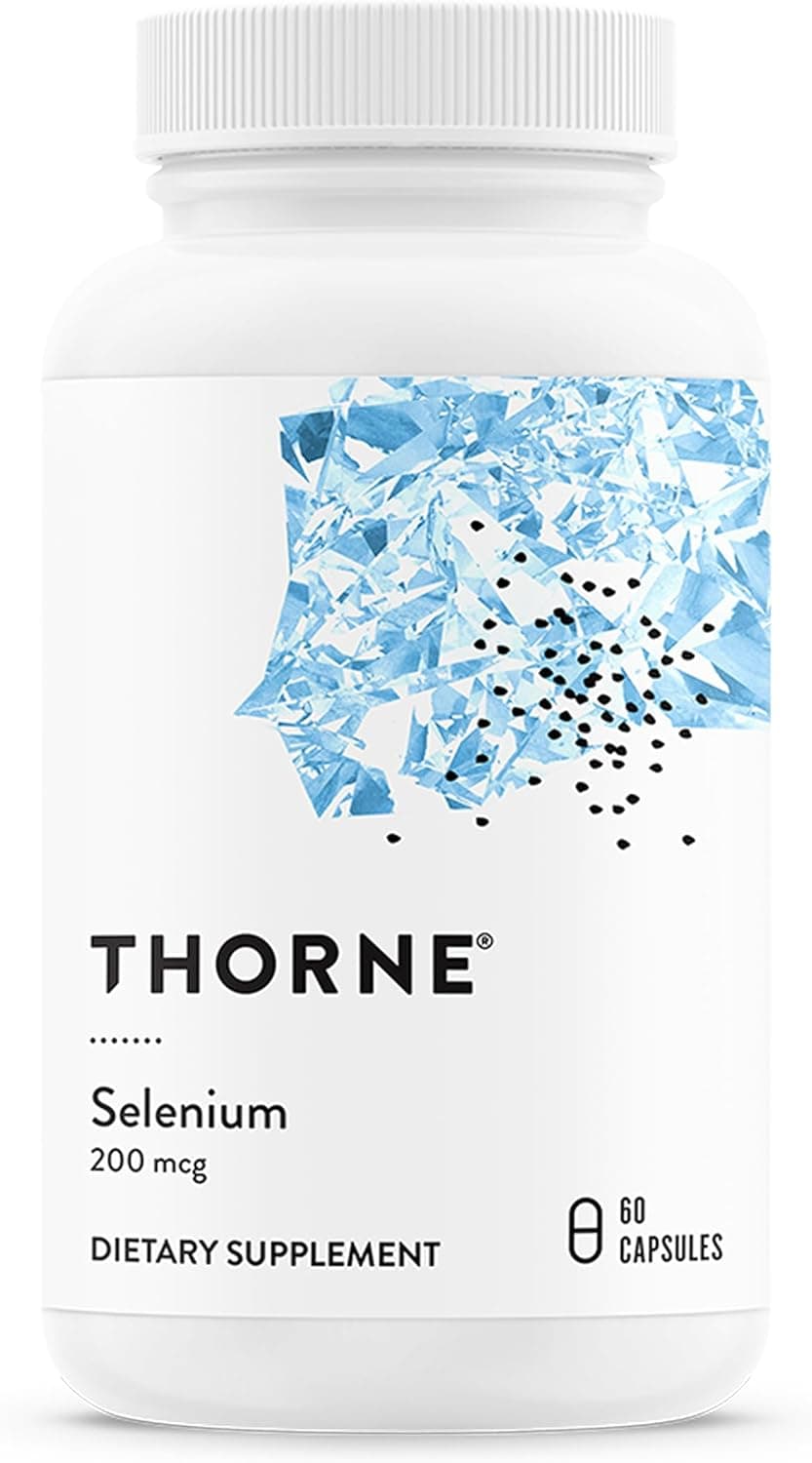
Thorne Selenium (Selenomethionine)
Thorne
The most evidence-backed product on this list — 200 mcg selenomethionine is the exact form shown to lower TPO antibodies in randomized trials.
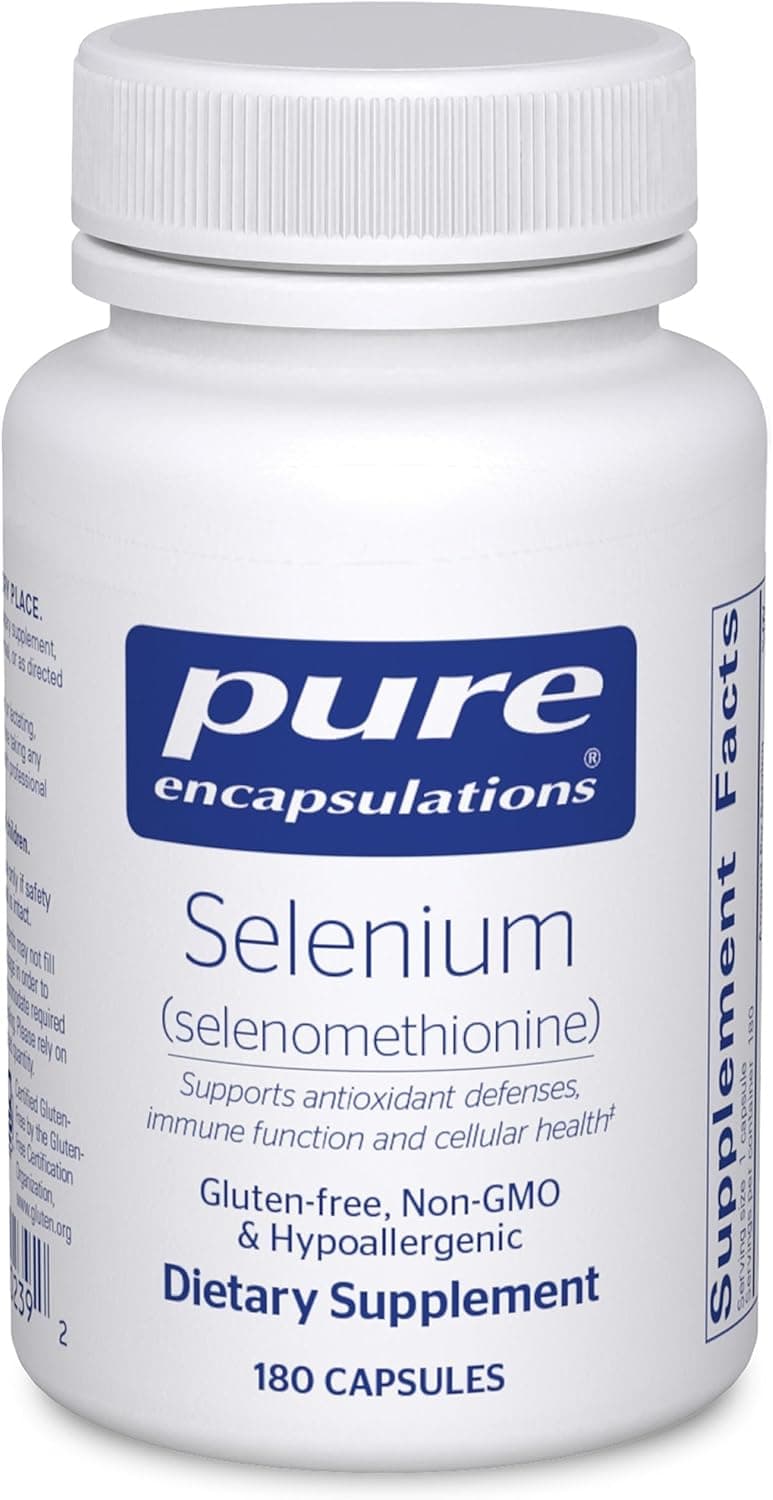
Pure Encapsulations Selenium (Selenomethionine)
Pure Encapsulations
Essentially the same clinical-grade selenomethionine as Thorne at a lower price — best value in the most critical Hashimoto's category.
Want the full picture? Read our complete Hashimoto's supplement protocol.